AI Advisor · Dependable AI
Ezzard Batiste
Independent evaluation and advisory for AI systems and agents.
I help organizations understand what their AI systems and agents can actually do, decide what authority they should have, and assess the evidence for relying on them. My approach draws on 25+ years building financial-market software, where permissions, controls, failure handling and operational evidence matter.
How much authority AI gets. Where controls sit. What the evidence supports.

When to reach out
It may be useful to talk when:
- You are considering giving an AI agent access to consequential systems or sensitive information, such as email, customer records, payments or production systems.
- You have deployed an AI system, whether built in-house, by a vendor or by another consultant, and want an independent look at its safeguards.
- You are relying on vendor assurances and want to understand what the available evidence actually establishes.
- Your leadership team must decide how much authority to delegate to AI, what oversight it needs and what risk is acceptable.
If someone you know is facing one of these decisions, I would welcome an introduction.
Capability is not dependability
As AI systems move from generating answers to taking actions, what they can do becomes inseparable from what they should be allowed to do.
Three questions shape my approach:
Where should AI be used? Whether a use case is worth pursuing depends partly on what the system would have to be trusted to do.
What should it be allowed to do? That means understanding its effective authority (what it can actually reach through tools, credentials and connected systems, not only what it has been told) and deciding which constraints are enforced outside the model.
What evidence would justify relying on it? That means matching the evaluation to the consequences, testing whether boundaries hold under realistic, adversarial and degraded conditions, and stating plainly what the results do and do not establish.
Model instructions are part of the design. But for constraints that matter, a model's own instruction-following shouldn't be the only safeguard.
Ways to work together
-
AI System & Agent Review
A focused, independent review of one AI system or agent: what it can actually reach, which safeguards are enforced outside the model, where failures could matter and what the available evidence supports. Findings, limitations and practical recommendations are stated plainly.
-
Executive Advisory & Education
Briefings and workshops that help leaders weigh AI opportunities, deployment risks and decisions about delegated authority and oversight. The field guide can serve as a starting point.
-
Ongoing Advisory
An independent technical and strategic perspective as you evaluate, deploy and oversee AI systems, with particular attention to authority boundaries and operational dependability.
Scope is shaped in an initial conversation.
Selected work & analysis
Instructions are not enforcement: a multi-step AI workflow
A personal project, not a client engagement.
- Problem. I used AI to produce a memorial program for a family member: text, photographs, page layouts and a printable PDF. My instructions were explicit: “Change only this.” “Do not alter any other photo.” “Lock this version.”
- Method. I iterated with increasingly precise instructions, then examined why changes kept disturbing work that had already been approved.
- Observation. Despite explicit instructions, fixing one element could revert or alter approved work elsewhere: crops returned to earlier versions, and photographs meant to remain unchanged acquired altered facial features. Reliability improved after I changed the workflow: returning to original image pixels, treating approved pages as locked masters and making deterministic edits.
- Implication. Better prompting has limits. For consequential work, approved state and constraints need to be protected by the workflow and system around the model, not only requested of it.
Background
For 25+ years, I've built software for financial markets, including market data and trading infrastructure. In those systems, failures have real consequences, and one principle held: no data is better than bad data. I now apply that same systems discipline to AI.
- Systems experience: low-latency C++/Linux, market data, trading and digital-asset systems, with roles at Intercontinental Exchange, Interactive Data, BGC Partners and Galaxy Digital
- Education: Computer Science, Harvard University; MBA, Yale School of Management
- Hands-on AI work: working with current AI systems and multi-step workflows, examining where they fail, how approved state gets lost or overridden, and what stronger controls and evaluation might look like
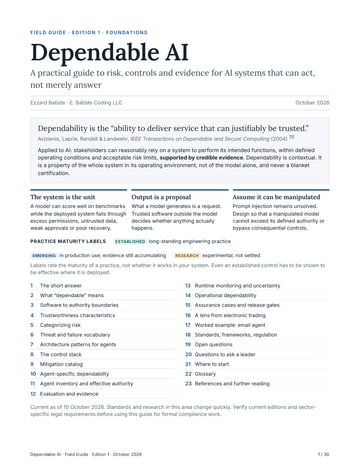
The guide
Dependable AI: A Practical Field Guide (Edition 1)
A 30-page practical guide to risk, controls and evidence for AI systems that can act, not merely answer. It covers authority boundaries, effective authority, controls outside the model, evaluation and operations, with a worked example and a lens from electronic trading. Free, no sign-up.
Writing
I write on LinkedIn about dependable AI: capability, authority, control, evaluation and evidence.
- When an internal AI coding agent removed a monitoring integration (Oct 2026), on OpenAI's incident report and what it shows about authority over safeguards
- An alert is not a control (Sep 2026), on why detection needs named stop authority and escalation
Featured interview
In a Humans of Fuzia interview, I discussed how a personal project sharpened my focus on dependable AI, why “no data is better than bad data” carries over from financial markets, and how I decide which opportunities are worth pursuing.
Get in touch
If you are evaluating an AI system, planning to use agents, or deciding how much authority to give AI in your organization, I would welcome a conversation.
Prefer email? [email protected]
LinkedIn (linkedin.com/in/ezzard-batiste)I am also glad to exchange perspectives with others working on these problems, and introductions are always welcome.